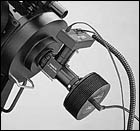
The
ideal CCD setup: the Pictor 416XTE imager autoguided by the
Pictor 201XT. |
For the beginner,
or for the most advanced observer, the real CCD revolution is
here!
Imagine with your telescope capturing an image of Jupiter that
appears to have been taken with a 36" observatory telescope. Or
obtaining, in 2 minutes or less, without guiding, an image of the
spiral galaxy M51 that out resolves 30-minute photographic exposures.
Or imaging a supernova in an obscure 18th-magnitude galaxy. Meade
CCD imagers can accomplish all of this, and much more! How such
results can be obtained is explained on a step-by-step basis, from
preliminary definitions to more advanced imaging techniques, in the
following Question and Answer section.
Q. What is a CCD imager?
A. A CCD ("charge-coupled device") is a detector sensitive
to light. When light (consisting of discrete photons) hits the
detector surface of the CCD sensor, electrons are liberated and
stored in the detector elements, or pixels.

Graphical representation of a CCD sensor.
|
A CCD sensor consists typically of
thousands of pixels. When a CCD imager is pointed at a brighter area
of the sky, a larger number of photons come in contact with the
chip. More photons generate a larger number of electrons. Thus, a
brighter portion of an image has a greater number of electrons
stored in each pixel.
Q. What is the basic role of CCD imaging in amateur astronomy?
Why are amateur astronomers using these devices?
A. The CCD imager attaches to the telescope's
eyepiece-holder in a roughly similar manner as a 35mm camera body is
attached. The imager allows a very fast "picture" (digital exposure)
to be taken of even faint celestial objects. This exposure can be
seen immediately on the display screen of a common personal computer
and, if desired, can be stored on a disc for future reference or
printed out to obtain a hard copy of the image. These points will be
expanded upon in the discussion that follows.
Q. What materials are CCD chips made of and what makes one
sensor "better" than another?
A. CCD sensors are made of semiconducting materials such
as silicon that have been manufactured to be sensitive to the impact
of light hitting their surfaces. Factors that can give one chip an
advantage over another are physical dimensions (the larger the chip,
the more sky area that can be imaged at one time); their pixel sizes
(smaller, more tightly-packed pixels result in higher image
resolution); the pixels' well capacity (the total number of
electrons that can be stored in each pixel before it becomes
saturated); fill factor (the percentage of the chip's area that is
sensitive to light); and quantum efficiency (the sensitivity level
of the chip to light).
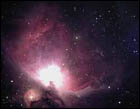
The
Orion Nebula (M42). Pictor 1616XT image by Jack Newton; 25"
f/5 reflector. |
Q. What is dark current?
A. In any pixel some undesirable electrons will be stored
that are not the result of light photons hitting the detector
surface. Some of these electrons result from thermal noise, a random
effect due to the interaction of heat with the CCD chip material.
The electric charge of these unwanted electrons–electrons that would
exist in the pixel even if there were no light coming in contact
with the chip–is called dark current. The effect of dark current is
to limit the practical length of a CCD time-exposure: ultimately,
dark-current electrons saturate the pixels so that no additional
photon-induced electrons can be generated. Thus, the lower the dark
current, the longer a CCD exposure can be.
Q. But I've heard that it is possible to "subtract out" the
effects of dark current.
A. Fortunately, dark current is highly predictable. By
taking a CCD image with the telescope optics covered (for the same
length of time as the intended image-exposure time) so that no
incoming light reaches the CCD chip, it is possible to measure the
dark current–electrons stored in the pixels when the chip is
literally in darkness–that will occur during the actual image
exposure. This dark current value can then be subtracted from the
total number of electrons stored in each pixel well, to obtain the
net number of stored electrons not due to dark current. While this
subtraction process is valuable to eliminate most of the effects of
dark current from the desired total of photon-induced electrons, it
does nothing to solve the problem mentioned above of dark current
pixel-saturation. The only real solution to this problem is to use
CCD chips that have very low dark current, and, as we will see
below, that is one of the important advances incorporated into Meade
CCD imaging systems.
Q. What is analog-to-digital (A/D) conversion?
A. The process of CCD imaging converts a smooth,
continuous, analog signal (e.g. the image of a galaxy) into a
series of discrete digits. Suppose, for example, that a galaxy's
image is divided into a large number of squares, with each square
covering a small area of the image, and that the varying brightness
levels in different squares are represented by a series of digits,
one through eight, where "1" is black (dark sky) and "8" is pure
white (the nucleus of the galaxy); digits in between represent
varying levels of gray. With this "digital" representation of the
galaxy we could compose a "discretized" picture of the galaxy,
replacing the smooth, continuous one that is in fact emitted by the
galaxy.
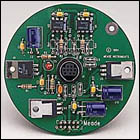
Electronic circuit board of the Pictor 416XTE CCD head.
|
Q. But isn't a smooth,
continuous image better than the discontinuous, unsmooth one you
just described?
A. If we use a large enough number of squares to cover the
galaxy's image (i.e. if the squares are small enough) and if the
quantity of digits used to represent all of the gray shades between
pure black and pure white is large enough, then the digitized image
becomes, for all practical purposes, smooth and continuous. In the
Meade Pictor 416XT CCD Imager, for example, the squares (pixels)
used to cover the incoming image are about 0.0004" (0.01mm) on a
side and shades of gray from pure black to pure white are
represented by 65,536 digits. In such a case the digitized image is
so smooth as to be virtually undetectable from a smooth, continuous,
analog image.
Q. That still doesn't explain why it is desirable to digitize
an image as you just described, instead of working with a continuous
image.
A. The answer to this question goes to the basis of all
CCD imaging. Once an image is digitized, an important range of
operations, called image processing, become possible, using
sophisticated image processing software such as Meade Epoch
2000ip. Such image processing is also possible with
analog-sensitive procedures, such as traditional photographic film
imaging, but the possibilities with photographic film are vastly
more limited than with the digital image output by a CCD chip.
Rather poor digitized images of celestial objects that are hardly
recognizable as originally imaged can be processed into magnificent,
beautiful images with good image processing techniques. Digital
image processing enables the extraction of a weak signal from
a large amount of noise.
Q. What are the other advantages of CCD imaging as compared to
photographic imaging?
A. Because of a CCD chip's greatly increased
light-sensitivity compared to film, exposure times are typically
much shorter; as stated above, a 2-minute unguided exposure of the
Whirlpool Galaxy (M51) with the Meade 216XT CCD Imager, for example,
outresolves photographic exposures of 30 minutes' duration. The CCD
image provides instant gratification–the image is immediately
visible on your PC display as soon as it has been taken, without the
normal darkroom work required of film. In addition film suffers from
a phenomenon called reciprocity failure: the photographic emulsion
becomes less and less sensitive as exposure time is increased; by
contrast, the response curve of a CCD imager is linear: twice
the exposure time yields exactly twice the results. And,
post-exposure image processing provides an amazing level of image
enhancement, an enhancement that is simply not possible with film.
With advanced image processing techniques, CCD images through
amateur telescopes have been taken of Jupiter, for example, that
exceed the level of detail that can be photographed through the
largest telescopes on Earth. As Mr. Jack Newton, one of the
world's foremost CCD imaging specialists, has said: "When I attach
the Meade Pictor 416XTE or 1616XTE to my 16" LX200 and expose and
co-add a couple of ten-minute exposures at a random position in
the sky, I am imaging faint background galaxies that quite
likely have never been imaged before with any telescope, amateur or
professional."
Q. Are you saying, then, that photography, and particularly
astrophotography, is an obsolete science?
A. Absolutely not. Even the largest CCD chips are small
compared to the formats of common films. The Meade Pictor 1616XT
includes one of the largest CCD units (13.80mm x 9.20mm in
dimensions) currently available, and yet it images an area less than
20% of the standard 35mm film format. (This problem is, however,
significantly reduced in importance by the mosaic feature of the
four Meade Pictor imager models, as we will see below.) And in a
sense, photography with a 35mm camera is perhaps more convenient to
the average user, since a PC and external power source are not
required. Notwithstanding the preceding words, however, there is
little question but that the future of imaging, whether for
astronomy or for recording a family gathering, lies in the CCD chip:
simply put, the boundaries of CCD imaging are almost endless; the
boundaries of photographic imaging, for all its rich history, are
not.
Q. You mentioned above that a large number of gray scales is
highly desirable in a CCD system. How does this relate to the design
specifications of a CCD imager?
A. The basic specifications of any CCD system state
whether it has, for example, an "8-bit," "12-bit," or "16-bit"
register, or converter. An 8-bit converter (i.e. an 8-bit
analog-to-digital conversion register) permits 2-to-the-8, or 256,
varying levels of gray to be digitized. CCD cameras (e.g., the Meade
Pictor 208XT) that include 8-bit converters yield a reasonably
satisfying level of smoothness and continuity to the image, but more
advanced cameras with 16-bit converters (e.g., Meade Pictor Models
216XT, 416XTE, and 1616XTE) present, by comparison, vastly enhanced
images in all respects. Imagers with 16-bit A/D converters yield
2-to-the-16, or 65,536, gray scales.
Q. What is thermoelectric cooling?
A. As stated above, dark current, one of the chief enemies
of any CCD imaging system, is the undesired random generation of
electrons into the pixel well, stimulated by heat in the environment
of the CCD chip. Dark current can be very significantly reduced by
lowering the chip's temperature. In CCD specification tables dark
current is specified at a certain temperature–e.g., dark current of
the Meade Pictor 216XT is "less than 8 electrons per 5 seconds at a
chip temperature of -5°C ." Achieving this low chip temperature
requires a cooling system. Thermoelectric cooling, the most common
method of CCD chip cooling, entails the input of an electric current
to two metal plates separated by a semiconducting material; the
result (the so-called Peltier Effect) is to make this thermoelectric
module act as a heat pump, pulling heat out of the CCD chip that
rests next to the module. The efficiency of heat dissipation is
augmented by radiating fins, included with all Meade Pictor CCD's.
On more advanced CCD systems, such as the Meade Pictor 416XTE and
1616XTE, thermoelectric cooling is cascaded with two similar
modules, resulting in 2-stage cooling which thereby reduces the
chip's operating temperature, and resultant dark current, still
further. The advanced cooling systems on all Meade Pictor imaging
models (208XT, 216XT, 416XTE, and 1616XTE) are regulated, meaning
that the cooling system automatically turns ON and OFF to keep chip
temperature close to the desired temperature.
Q. What is flat-field compensation?
A. Due to manufacturing considerations in the production
of any CCD sensor, not all of the chip's pixels have the same level
of sensitivity to light; small variations in the thickness of the
chip can affect sensitivity. In addition light does not hit the chip
uniformly due to natural optical vignetting, however small, of the
image by the telescope's optics. Total sensitivity variations can
easily reach 5% to 10% from place-to-place on the chip, variations
which become apparent in the imaging of faint objects. To minimize
these vignetting effects, Pictor models facilitate combining a
flat-field exposure with the actual image; this process is called
flat-field compensation.
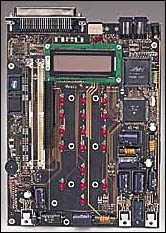
Electronic circuit board of the Pictor 1616XT control
unit. |
Q. I've heard that an
effect called blooming can also be a problem with CCD's.
A. CCD images of bright objects, such as first-magnitude
stars, sometimes show the effects of blooming. This effect, visible
as a trail of light emanating from the illuminated pixel (similar in
appearance to one spike of a "spider diffraction" pattern in a
Newtonian reflector), is due to a spillover of electrons from a
fully saturated pixel. All Meade CCD systems have built-in blooming
correction, reducing the probability of streaking in an image.
Q. How is a CCD imager actually used with the telescope?
A. CCD imaging requires three basic components: the
telescope, the CCD imaging system, and a personal computer (PC). In
the simplest format, the CCD head, containing the CCD chip
itself, is placed into the telescope's eyepiece-holder in place of
an eyepiece; the object to be imaged is centered and focused on the
CCD chip; the image is taken, and the image data are transferred and
processed by the PC. The image is immediately displayed on the PC's
monitor. (With all Meade CCD models, CCD operating and image
processing software is included on a floppy disc that is loaded into
the PC before starting.) Meade Pictor Models 208XT and 216XT include
all of the associated control electronics inside the same CCD head;
Models 416XTE and 1616XTE, because of their larger,
higher-resolution chips, and consequently more sophisticated control
systems, utilize a separate control box.
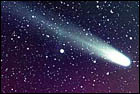
Comet
Hyakutake (C/1996 B2) as imaged by Jack Newton with a Meade
Pictor 1616XT and 50mm telephoto lens.
|
Q. Is it really that simple?
I've heard that CCD imaging can be something of a chore.
A. Before the advent of the Meade Pictor Series your
statement was often true: CCD imaging usually required a knowledge
of PC techniques and a flair for working with a rather complex piece
of hardware. Using a Pictor system, CCD imaging is accessible to
anyone with an interest in astronomy or photography. To illustrate
the contrast between any of the four Pictor models and other CCD
imagers, consider this summary of the imaging procedure required of
typical competing units, even very expensive ones: after the
telescope, imager, and PC are set-up, the operator must set the
imager temperature; take a flat-field exposure use an eyepiece to
center a medium-bright star in the field, focus the star in the
eyepiece; re-check focus of the star with the imager in the
telescope; center on the CCD chip the object to be imaged; if not
centered, use the telescope's drive corrector to center the image;
re-check focus of the object; specify image exposure time; take dark
frame exposure; take actual image exposure. Keep in mind that the
foregoing is a summary of what is required without a Pictor
CCD and without a Meade LX200 telescope. It is not uncommon for an
operator to spend one hour simply preparing to take the image
exposure!
By contrast, Meade Pictor Models 208XT, 216XT, 416XTE, and
1616XTE are "point-and-shoot:" to take an image, center and focus it
on the chip and click on a button on the PC display. The imager
automatically determines the appropriate exposure time, takes
the required dark current frame, and stores it in memory. The imager
gives the user the option of taking a field-flattening image and
storing it in memory, then takes the actual exposure, and stores the
resulting image, again after automatically subtracting out the dark
current compensation frame.
Q. I've heard that centering and focusing the image on the CCD
chip can be a frustrating task.
A. Indeed it can be, but again the Pictor Series has made
great improvements on both of these points. Once an object is placed
anywhere on the chip, imaged, and downloaded to the PC, the
Pictor's autocenter feature allows the user simply to click
the PC's mouse on the PC display at the desired center of the image.
The Pictor then automatically moves the telescope to center the
object on the chip and retakes the image. If you're using your
Pictor CCD with a Meade LX200 telescope equipped with the Meade
#1206 Electric Focuser, images can be automatically focused.
Trial-and-error focusing, taking test shots, and refocusing are no
longer necessary. Even without an LX200, a Pictor's
fast-frame mode enables viewing an-image-a-second to
facilitate focusing.
Q. During the period of a CCD time-exposure, is it important
to "guide," or correct, the telescope position, as in
astrophotography?
A. Precise guiding of the CCD camera during a CCD time
exposure is as critical to successful results as is guiding during a
long-exposure astrophotograph. This guiding can be accomplished in
any of the following ways: (a) by using the Shift-and-Combine mode
of the imager; (b) by manual monitoring of a guide star, using a
guiding device such as the Meade Off-Axis Guider and an Illuminated
Reticle Eyepiece in conjunction with a drive corrector; or (c) by
using an electronic autoguider, such as the Meade Pictor 201XT CCD
Autoguider. In the latter case the autoguider senses the telescope's
position and sends signals to the drive corrector to initiate very
small changes in telescope position during the time exposure. Use of
the CCD Autoguider has several advantages over the manual method; in
general it is much more precise and error-free than is possible with
manual guiding, and, in the case of the Meade Pictor
201XT, the autoguider can guide on guidestars as faint as
12th-magnitude, far fainter than is possible during manual guiding.
The autoguider may also be employed for long-exposure
astrophotography. See for details. The Pictor 201XT is available
separately or as part of the Meade CCD Accessory Package, a package
that includes all of the required instrumentation and software for
advanced long-exposure CCD imaging.
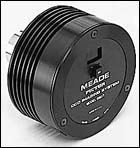
CCD head
of the Pictor 208XT. |
Q. Could
you elaborate on the special advantages of using a Meade LX200
Schmidt-Cassegrain with a Meade Pictor Series CCD Imager?
A. In fact the advantages are almost overpowering, since
Meade LX200's were designed with an eye toward the requirements of
CCD imaging. These advantages apply to all Meade Pictor
imager models and all LX200 models: (a) Autocentering:
use your PC's mouse to click on to an object at the edge of the CCD
chip, click on the centering tool, and the telescope microslews
automatically to center the object on the chip; (b)
Autofocusing: Accurate, hassle-free focusing was perhaps the
biggest single headache in pre-Pictor imaging. With the Meade #1206
Electric Focuser attached to any LX200 model, by actuating
Autofocus the image is automatically, and precisely, focused
in seconds. (c) Automosaicking: In the Automosaic mode the
LX200 moves automatically to image an arbitrarily large number of
operator-specified sky areas adjacent to the originally imaged area.
In this way image montages can be created to stunning effect. (d)
High-Precision Pointing: With their pointing accuracy of one arc
minute or less, Meade LX200's in the HP-mode can be used to place
even the faintest objects on any Meade CCD chip, first time, every
time. (Importantly, note that even LX200's manufactured before the
HP-mode feature was built into the telescopes can achieve much the
same result, though not semi-automatically as is the case with
built-in HP-mode pointing, simply by using the SYNC command and
centering any database object located within a few degrees of the
desired object.) There are no other commercial telescopes and no
other CCD systems currently manufactured that permit the above
operations or the above-stated pointing accuracy.
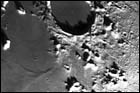
Pictor
416XT image of the Moon, showing craterlets on the floor of
Plato at top-center; image by Dr. Donald Parker; 16" f/6
reflector. |
Q. Can Meade
ED Apochromatic Refractors, or other telescopes mounted on
Meade LXD 650 and 750 equatorial mounts, achieve all of the above
LX200 advantages as well?
A. Yes. All of the above-listed, unique LX200/Pictor
advantages apply equally as well to telescopes mounted on Meade LXD
650 or 750 equatorial mounts, provided the mounts are equipped with
the Meade #1697 Computer Drive System.
Q. Meade Pictor Models 208XT and 216XT use the Texas
Instruments TC-255 CCD chip. I notice that this same chip is used on
competing CCD models that sell for much higher prices. How is this
possible?
A. The TC-255 CCD chip is the most advanced CCD chip
available for imagers in the mid-price range, and, without
qualification, Meade Models 208XT and 216XT permit the highest
levels of performance of any imagers available in this range. All
four Meade CCD imagers are generally less expensive, and yet with
far more features and performance, than competing units for several
reasons. Meade Instruments budgeted large sums of money for more
than one year to develop the Pictor Series; one result of this large
capital outlay is that we can, probably without exception,
manufacture higher-quality CCD's at much lower unit costs than our
competitors. Our design philosophy in developing the Pictor Series
was not to offer "just another series of CCD imagers," but to make
Meade imagers the finest such units on the market. And yet, because
our operating overhead is spread out over such a wide range of
astronomical products–including over 40 telescope models and 250
accessory products–our unit costs put us in an extremely competitive
position.
Q. What is the value of the SCSI interface included with the
Pictor 416XTE and 1616XTE?
A. The SCSI interface permits data
from the large Kodak CCD chips used in the Pictor 416XTE and 1616XTE
to be downloaded to the PC in a fraction of the time required by
serial downloading, the type of downloading included with other
brands of CCD systems. For example, on one competing (and rather
expensive) CCD imager, after each attempt at focusing the image, the
user must wait for a period of 5 to 20 seconds before the image
appears on the PC display, and then, through repeated trial and
error, ultimately try to reach correct focus. The fast SCSI
downloading of the Pictor 416XTE permits focusing virtually in
real time: focus and see the result immediately. The Pictor
1616XTE, with its extremely large, high-resolution CCD chip requires
a maximum of 4 seconds for full-frame downloading.
Q. I understand that some competing CCD models can not
practically be used for imaging the Moon and planets, or are badly
compromised in doing so. Is this also true of the Meade Pictor
Series?
A. No. Some CCD chips are downloaded (i.e. data is
read out from the pixels to the PC) without any shutter mechanism to
block light from hitting the CCD during the readout. As a result,
images of bright objects, such as the Moon and planets, can be badly
smeared. Meade Pictor CCD's solve this problem in one of two ways:
on Models 208XT and 216XT, the TC-255 chip uses a
frame-transfer system that rapidly moves the image from the
chip's active area to an inactive area not affected by incoming
light, thus creating an electronic shutter that can image in
exposure times as short as 4 milliseconds. Pictor Models 208XT and
216XT are as a result excellent lunar and planetary imagers, in fact
the best available short of the Pictor 416XTE. On Meade Pictor
Models 416XTE and 1616XTE a sophisticated electromechanical shutter
is provided that can image exposures as short as 1/100-second.
Combined with small (9.0µm square) pixels, low readout noise, and
2-stage thermoelectric cooling, Pictor Models 416XTE and 1616XTE are
truly awesome in their imaging capabilities, whether for lunar,
planetary, or deep-space.
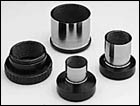
Alternate barrels for Pictor models: SCT rear-cell
thread; .965"; 1.25"; and 2". |
Q.
You have mentioned dark current as a potential problem in CCD
imaging. Are there other sources of unwanted electrons that can
affect imager performance?
A. The answer to this question is a bit technical, but it
is vital to an understanding of why Meade Pictor CCD's are such an
improvement over other CCD systems currently available. In fact
there are numerous sources of random noise in and about each pixel:
noise caused by the A/D conversion discussed above, as well as,
among others, readout noise, the noise caused simply by
reading out a pixel's electron value and sending this value on to
the PC for processing. Readout noise is independent of exposure time
and complicates the taking of very faint images. The TC-255,
KAF-0401E, and KAF-1602E CCD sensors used in Pictor Series CCD
systems all have very low readout noise. Most other noise sources
increase as the square root of time. Stored electrons which are the
result of incoming photons (i.e. desirable electrons
generated by the incoming image signal) increase directly
proportional to time. The effect of the preceding statements is
that the longer the CCD exposure time, the less the relative
effect of noise on the desired incoming image signal. Equivalently,
CCD engineers say that signal-to-noise ratio increases with
exposure time. Thus longer CCD exposures have an added value
beyond the fact that they result in more incoming signal value: they
also result in relatively less noise than do shorter exposures. And,
because all Meade Pictor CCD chips have such low dark current, long
exposures (often impossible on other CCD systems because of dark
currents that are 5 to 20 times higher) are not only practical, but
highly desirable.
Q. How should Meade CCD systems be used in the field, where
there is generally no source of alternating current?
A. All Pictor Series CCD units operate from 12 volts DC. A
cord for powering each CCD from an automobile cigarette lighter plug
is included with each model; optional Meade adapters are available
for operating from standard 115v.AC outlets. For safety reasons
only a laptop PC should be used in the field, since this type of PC
can also be powered from the 12vDC auto cigarette lighter plug.
(AC-powered PC's are not designed, and are not safe, to use
outdoors.) Alternately, the telescope-with-CCD head may be set
up outdoors and the (AC- or DC-powered) PC remotely operated indoors
by a cable link between the CCD and PC. Such cable links up to 100
ft. are possible with any Pictor model.
Q. Meade Pictor models, as noted throughout this discussion,
have all recently been changed from "201, 208, 216, 416XT, and
1616XT," to have XT and XTE suffixed to each
respective model number–such as 201XT, 208XT, 216XT, 416XTE, and
1616XTE. What are the major differences between the previous models
and the XT/XTE-series?
A. All five Meade Pictor CCD models underwent extensive
updating in hardware and/or software, as part of a continuing
program at Meade Instruments to maintain Pictor imagers as the
finest, most advanced imagers available to the amateur astronomer.
The XT (Extended Performance) Series 201XT, 208XT and 216XT include
more than 40 substantive improvements and additions in software
alone. The new 416XTE and 1616XTE imagers are equipped with the
latest blue-enhanced Kodak E-series CCD sensors.
Q. I notice that Pictor 208XT and 216XT CCD imagers are very
moderately priced. Do these price levels come at the expense of
important imaging capabilities?
A. Meade Pictor 208XT and 216XT CCD imagers were designed
with one overriding thought in mind: to make high-performance CCD
imaging and autoguiding available to the thousands of amateur
astronomers throughout the world who were discouraged from entering
the field because of the relatively high prices of previous CCD
imaging cameras. Frankly speaking, Pictor 208XT and 216XT are
absolutely revolutionary in both their performance and pricing:
there are no other CCD imagers available from any source with the
combination of capabilities and pricing offered by the 208XT and
216XT. As the images shown throughout the Meade Website
indicate, the 208XT and 216XT are imagers fully qualified to yield
amazing results, results that were undreamed of except from the most
expensive CCD cameras only a few years ago.
Q. What are the primary differences between the Pictor 208XT
and 216XT?
A. The 208XT provides for 8-bit A-to-D conversion; that
is, the number of gray scales, as discussed above, is limited to
2-to-the-8 or 256, digitized levels of gray. Notwithstanding this
somewhat limited number of gray scales, the 208XT is without
question an excellent imager for the beginning to intermediate user,
and spectacular results can be achieved with telescopes in the 6" to
12" aperture range. The Pictor 216XT permits 12- or 16-bit imaging,
yielding, respectively, 4096 or 65,356 levels of gray, with a
consequent significant improvement in image resolution. In addition
the 216XT includes software, not available for the 208XT, that
allows for color imaging, using the Pictor 616
Color Filter System. For the great majority of amateur
astronomers the Pictor 216XT is all the CCD imager ever required;
the 216XT, in experienced hands, is an advanced imaging tool
that yields professional-quality images of the Moon, planets, and
deep-space.
Q. You call all of the Pictor Models 208XT, 216XT, 416XTE, and
1616XTE "Autoguider/Imagers." Can all of these systems independently
autoguide and image?
A. Yes. All four models, including the least-expensive
Pictor 208XT, can be used to (a) autoguide a photographic exposure,
and (b) autoguide the imager itself in a
shift-and-combine mode–the imager takes a series of, say,
2-minute exposures and after each exposure the image is stored
(combined) on "top" of the previous images; between image
exposures the Pictor briefly autoguides, making any necessary
position corrections. The shift-and-combine mode of all models is
automatic: just input from the PC keyboard the number of
exposures desired and the exposure time, and Pictor software does
the rest, even calculating the proper integration time for the
autoguider.
Q. How about color imaging with the Pictor Series. Is this
possible?
A. The Meade #616 Color Filter System connects directly to
Pictor Models 216XT, 416XTE, and 1616XTE and enables superb
tri-color imaging, fully automatically, without the tedious
trial-and-error approach of other CCD systems.